Mainly we are using music/audio editing apps to create music and ringtones. Using those apps, you can edit, mix, and cut the music apps. Are you looking for best music editor app for your iPhone and iPad? If it is so, this article will help you to pick one. 5 best music/audio editor apps for iPhone and iPad 1.Garageband. Editing Podcasts in GarageBand Once you’ve recorded your audio, you will probably want to edit it in some way, whether it’s fixing your mistakes or adjusting the volume. Once you’ve made a recording, you can play it back by dragging the playhead to the beginning and pressing the spacebar. He adjusts the volume by selecting points and dragging them up or down. To modify the sound, he goes to the Track menu, chooses Info, and uses the filters. When you're done, go to the Share menu and export the file. This is a good instructional video for learning how to use GarageBand to edit existing audio files. I want to edit a piece of audio in Garageband. This piece of audio is not linked to any video - all I want to do is edit some parts out. Can I use GarageBand to do? How do I pull in the audio only for editing.
GarageBand User Guide for iPad
You can edit cells in the Live Loops grid in a variety of ways. You can cut, copy, and paste cells, move cells, delete cells, and change cell settings. When you turn on cell editing, you cannot start or stop playback of cells (but you can edit cells that are already playing).
You can also copy regions in Tracks view and paste them in the grid, in a row using the same instrument as the track they were copied from.
Turn on cell editing
Tap the Edit Cells button in the lower-left corner of the Live Loops grid.
To turn off cell editing, tap the Edit Cells button again.
Cut a cell
Double-tap the cell, then choose Cut from the Edit menu.
Copy a cell
Double-tap the cell, then choose Copy from the Edit menu.
Paste a cell
Double-tap a cell, then choose Paste from the Edit menu.
You can paste a cell in another row using the same Touch Instrument as the row it was copied from. You can also paste a cell from a row using the Audio Recorder or Amp to another row using either of these instruments, and paste a cell from a row using the Keyboard or Sampler to another row using either of these instruments. The cell takes the sound of the Touch Instrument in the row you you paste it to.
Move a cell
Touch and hold a cell, then drag it to an empty cell in the grid.
If you drag it to a cell that is not empty, the contents of the starting cell and the destination cell are swapped.
You can move a cell to another row using the same Touch Instrument as the row it was moved from. You can also move a cell from a row using the Audio Recorder or Amp to another row using either of these instruments, and move a cell from a row using the Keyboard or Sampler to another row using either of these instruments. The cell takes the sound of the Touch Instrument in the row you you move it to.
Delete a cell
Double-tap the cell, then choose Delete from the Edit menu.
Edit cell contents
Double-tap the cell, then choose Edit from the Edit menu.
You can edit the cell contents, similar to editing regions. For green cells, you can also edit notes in the cell, similar to editing notes in a region.
Change cell settings
Double-tap the cell, then choose Settings from the Edit menu.
Change one or more of the cell settings:
Gain: Drag the Gain slider left or right to adjust the cell’s volume (blue and yellow cells only).
Velocity: Drag the Velocity slider left or right to adjust the cell volume (green cells only).
Time Snap: Choose the Time Snap value for the cell.
Play Mode: Choose the play mode for the cell.
Looping: Tap the Looping switch to turn on looping for the cell.
Follow Tempo & Pitch: Tap to have the cell follow the song tempo and key (blue cells only).
Octaves: Tap the – and + buttons to raise or lower the pitch (green cells only).
Semitones: Tap the – and + buttons to raise or lower the pitch.
Speed: Drag the Speed slider left to right to change the speed (tempo) of the cell.
Reverse: Tap the Reverse switch to have the cell play in reverse.
Reset All: To reset all cell settings, tap Reset All.
When you finish, tap Done.
While the Cell Settings menu is visible, you can tap the selected cell to start or stop playback, in order to hear your changes. You can also tap other cells and edit their settings.
Edit a column trigger
Tap a column trigger , then tap one of the editing commands.
Show a row in the Tracks view
In the Live Loops grid, double-tap a row header, then tap Show in Tracks view.
Show a track in the Live Loops grid
In Tracks view, double-tap a track header, then tap Show in Grid.
Tutorial: GarageBand—Basic Editing
Introduction
GarageBand is an ideal software package—easy to use, included on every Mac, and capable of editing interviews quickly. The process of editing audio content by editing waveforms is standard across all audio programs. The actual mechanics for making the edit may differ, but every software package will include a way to cut out unwanted material and join the sound you want to use.
This tutorial provides an introduction to audio editing through GarageBand.
You can download the raw file, a rough edit and the finished audio of the file used in this tutorial from the Apple web site. The files are in the right column.
Setting up GarageBand
Open GarageBand.
GarageBand requires you to select a project type.
Choose Podcast (1) and click Choose (2).
This is the podcasting screen. The first step is to simplify the interface.
Click the Edit button (1) and the Media button (2) to close those two panels.
This interface is less complex.
Select Hide Podcast Track from the Track menu.
The screen is even less complex.
Turn off Ducking. [Ducking is a way to automatically lower the background sound when the foreground sound is louder.]
Ducking is off and there are no ducking controls in the track head.
Delete all but one track—GarageBand requires at least one track.
Position the Finder Window containing the audio source files at the top right of the Finder window.
Omnisphere 2 ich will download. A guarantee so solid, you never have to worry about price when shopping at zZounds We'll beat any priceSimply click the Seen it for less? Nothing to track.No application to mail or fax, no bills to pay.We automatically charge the payments to your credit card.We'll wait on your money so you don'thave to wait for your gear!When you checkout, just click the Play as you Pay® checkbox toindicate which installment plan you wish to use.
Importing and Editing
After you setup a Finder window in the upper right corner of your desktop drag a single file into a blank spot in Track Head area.
Each file you drag will appear in a separate track.
The imported audio will appear in a new track.
The new track will have the imported audio file name as the track title. The track waveform will be orange. The orange track color indicates that this is an imported audio file. Voices and Real Instruments recorded directly into GarageBand are color-coded purple. Midi instruments are coded green. Loops are aqua.
Open the edit panel (1).
Click the play control or press the spacebar to play the audio. Press the stop button or the spacebar to stop the playhead at an edit point. Note that the playhead in the multitrack view (1) and the playhead in the Editor (2) show exactly the same point on the waveform. The waveform in the edit window is larger and can be zoomed independent of the multitrack view. This permits precision edits on the waveform.
May 10, 2016 I have a Rane TTM 57SL Mixer (Serato ScratchLive interface built into it) and the software does not want to work together with Windows 10. I know Serato and or Rane hasn't came out with an update for 10 yet and not sure if they plan to. It works fine with 7 and 8 but don't want to have to buy a previous windows if I can fix the problem on 10. . Connect the equipment into an outlet on a circuit different from that to which the receiver is connected. 2 RANE TTM 57SL MIXER FOR SERATO SCRATCH LIVE. OPERATOR’S MANUAL 2.4.4. Introduction Please read through these operating instructions so you will know how to get. Jul 18, 2011 ttm57sl dont connect to scratch live. Ttm57sl dont connect to scratch live. A read-only archive of old serato.com help threads. Ttm57sl dont connect to scratch live. I got an asus notebook N53jf and i tryed everything to connect the ttm57 mixer with the software. At last i got (code 10) error, driverproblems. Why is my TTM57SL not being recognized by Scratch Live 2.4.0 and above? Some users on Mac computers have been receiving the 'hardware disconnected' message when connecting their Rane TTM 57SL after updating to Scratch Live 2.4.0 and above. 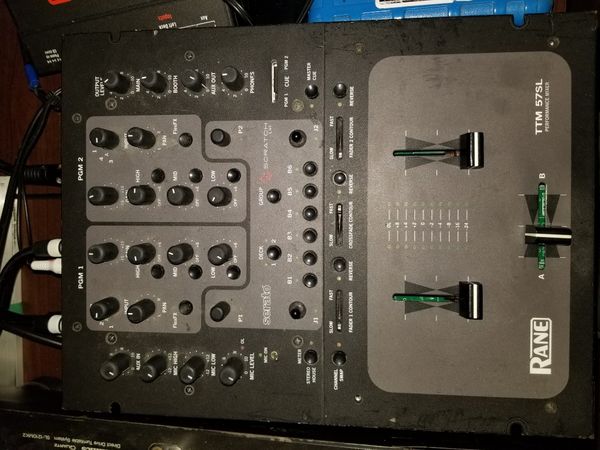
After you select an edit point, select Split from the Edit menu. Note the Command T keyboard shortcut. Most of the work in editing is making cuts.
The first edit is complete. Note the left edit has a unique region name—cryptobotany.raw.1—(1) and the right edit has a unique region name—cryptobotany.raw.2—(2).
Now that the first edit is complete, you’ll want to delete the left part of this edit—cryptobotany.raw.1 (1). However, after the edit note that both the left region, cryptobotany.raw.1 and the right region, cryptobotany.raw.2 are highlighted.
If you hit the Delete key with both regions highlighted the entire track will be deleted. This frequent mistake is easily corrected. Hit the Command and Z key to undo the mistake.
Select just the left region—cryptobotany.raw.1—and press the Delete key.
The left region is deleted and the edit is complete.
Here’s an example of garageband’s non-destructive editing capabilites. Press Command and Z to undo the delete. Now, select just the right region—cryptobotany.raw.2—and press the Delete key.
Notice the special cursor that appears when the mouse is positioned over the lower right corner of the track in the precision editing window.
Click and drag the track to the right. The material that was just deleted reappears.
Removing a section in the middle of the track is only slightly more complicated.
Make a cut (split track) on each side of the sound section that will be removed.
Deselect all track regions by clicking in an empty grey area.
Select the section to delete and press the Delete key.
The section is deleted. The next task on the edit is to close the gap between the two remaining regions and join the two regions together.
Audacity
Select the right region in the multitrack (upper) window—you cannot move a region by clicking in the Edit panel—and move the region to the left until it is adjacent to the the left region.
Highlight both the left and right regions.
Select Join from the Edit menu.
Two important changes occur. First the two regions are joined. The region label reads cryptobotany raw.3.merged. GarageBand has merged the two files and has written a new temporary file. GarageBand can now handle this file in the same way as a sound recorded directly into a GarageBand project.
Editing an interview primarily consists of cutting out reporter questions and removing segments of the interview that are not necessary for the report or project.
Exporting
Garageband Ipad Audio Editing Software
After finish editing, you need to export the interview.
Move the End Marker before exporting.
Click the End Marker in the Multitrack window ruler and drag the maker to the end of the interview.
The End Marker is correctly positioned and the project is ready for export.
Select Export Song to Disk from the Share menu.
If you are using this sound project in Final Cut Pro or any other program that will import uncompressed sound files, do not check the Compress checkbox.
If you are using this sound project in SoundSlides or any program that requires a compressed file, check the Compress checkbox and select the method of compression and the settings. This setting is for Soundslides and is set to the required MP3 file format and uses the 128 kbps setting.
Give the export a name (1) and check the location (2) to make sure you know where the file will be saved. Then click the Save button (3).
About this Tutorial
Jerry Monti is a technology trainer for the Knight Digital Media Center.
Republishing Policy
This content may not be republished in print or digital form without express written permission from Berkeley Advanced Media Institute. Please see our Content Redistribution Policy at multimedia.journalism.berkeley.edu/content_redistribution/.